General-purpose language models are good at general tasks. Sometimes you need one to behave in a specific, consistent way for your business: classify incoming requests into your categories, write in a particular format, or follow a house style. Supervised fine-tuning, or SFT, is one way to get there.
This article explains what SFT is, what it is and is not good for, and how it compares to simpler options. For most small businesses, those simpler options come first.
What SFT is
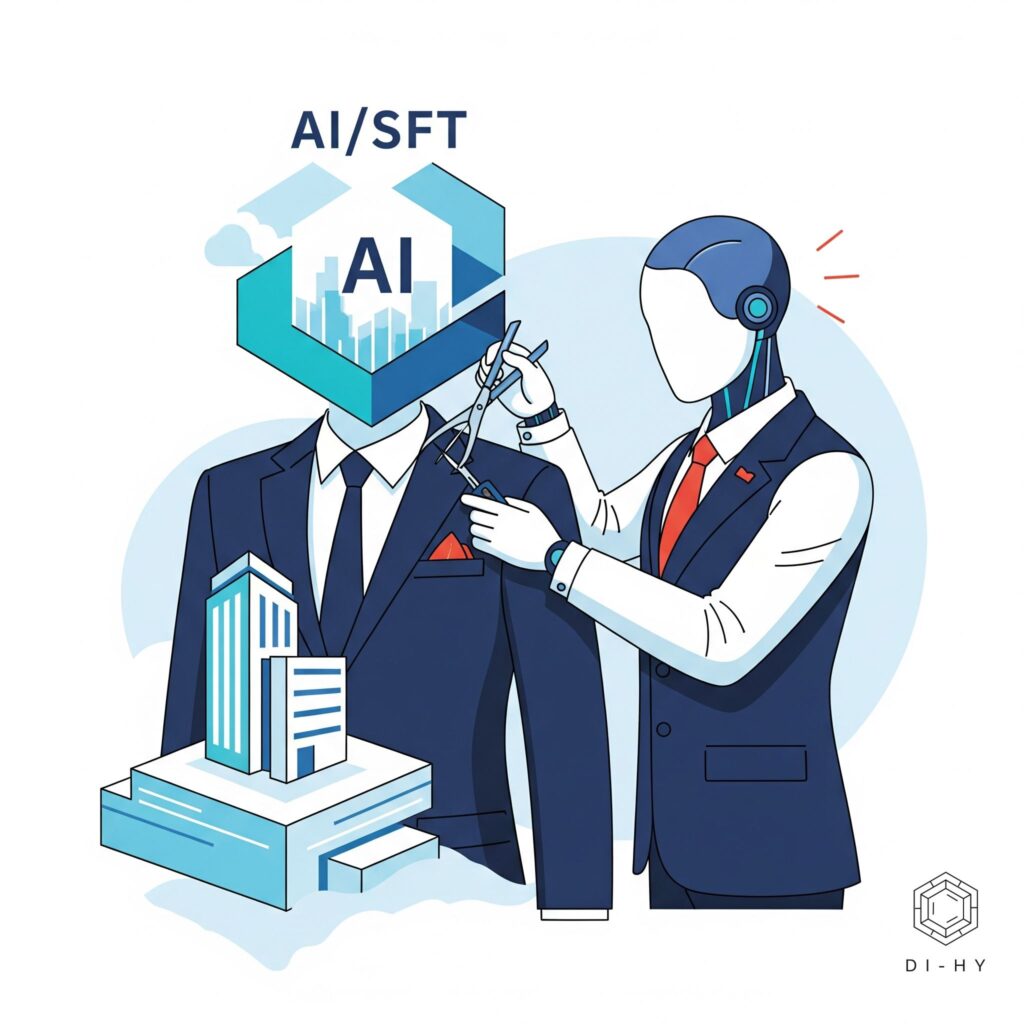
A pre-trained language model has already learned from a very large body of text. Supervised fine-tuning continues its training on a smaller, curated set of examples. Each example is a pair: an input and the correct output.
OpenAI's documentation describes it as training a model on examples for your use case, producing a customized model that more reliably produces your desired style and content. The examples are "examples of correct responses to prompts to guide the model's behavior," often written by humans.
SFT is also a standard step in how major assistants are built. In the 2022 paper "Training language models to follow instructions with human feedback," Long Ouyang and colleagues fine-tuned language models using human-written demonstrations and human feedback. In their human evaluations, outputs from the 1.3-billion-parameter InstructGPT model were preferred over those of the 175-billion-parameter GPT-3, despite having 100 times fewer parameters. The lesson is that targeted training data can matter more than raw model size.
What SFT is good for
SFT shapes behavior. It is a fit for tasks where you can show the model what a correct answer looks like. OpenAI's guide lists these example uses:
- classification
- nuanced translation
- generating content in a specific format
- correcting instruction-following failures
It is a poor fit for teaching a model facts that change. A price list, a warranty policy or a parts catalog will be out of date the moment it changes, and retraining each time is slow. Supplying documents at question time is the better tool for that, and it is called retrieval-augmented generation.
SFT, RAG or better prompts?
Try them in this order.
| Approach | What it changes | Best for | Effort |
|---|---|---|---|
| Better prompts and examples in the prompt | The instructions the model sees each time | Most first projects | Low |
| RAG | The documents the model can see at question time | Answers that depend on your changing information | Medium |
| SFT | The model's behavior | Consistent format, style or classification at scale | Higher |
If a clear prompt with a few examples gets you most of the way, stop there. Fine-tuning pays off when you run the same task thousands of times and a prompt cannot make the output consistent enough.
What it takes to try SFT
Examples
The data matters more than the model. OpenAI's guidance is to start with around 50 well-crafted examples, evaluate, and add more only if performance improves. Its documented minimum is 10 examples, and it says improvements are typically seen with 50 to 100, though the right number varies by use case. It also advises that if 50 examples have no impact, you should rethink your task or prompt before adding more training data. Examples should be realistic and drawn from historical, expert or logged data.
A test before you start
OpenAI's guide says to set up evaluations first, so you can tell whether the tuned model actually beats the base model. Write a set of real inputs with the correct outputs, and score both versions.
Privacy and consent
Training examples often come from real customer messages and call logs. Remove personal details you do not need, and check your vendor's terms on how training data is stored and used. Our AI compliance guide for small service businesses has the questions to ask.
Availability
Check what your vendor offers before you plan around it. As of October 2026, OpenAI's fine-tuning documentation says that it is winding down its fine-tuning platform and that new users can no longer access it. Options change, which is another reason to start with prompts and retrieval.
The risks of fine-tuning
Fine-tuning has costs that do not show up on the first demo.
- It freezes behavior in time. If your categories, services or tone change, you retrain. A prompt can be edited in a minute.
- It can learn your mistakes. If past examples include inconsistent or wrong answers, the model copies them. Someone has to clean the examples.
- It is harder to explain. When a prompt-based system gets something wrong, you can read the prompt. When a tuned model does, the cause is spread across the training data.
- It does not add reliable facts. A tuned model can still state wrong details with confidence. Pair it with retrieval or a review step wherever accuracy matters.
None of this means SFT is a bad idea. It means the decision should come from a measured gap, not from the appeal of a custom model.
Where it could fit in a service business
These are illustrations, not results from a specific company.
- Sorting inbound requests: labeling each message as an emergency, a quote request, a billing question or a spam message, using your own definitions and several hundred past examples.
- Writing in a fixed format: turning a tech's rough job notes into your standard invoice description.
- Matching your voice: drafting replies in the tone your company uses, trained on replies a manager approved.
Each is a narrow, repeated task with a clear right answer, which is where SFT is strongest. For a wider look at where AI fits in a trades company, see AI agents for service businesses. If you want help deciding which approach fits a project, Di-Hy's AI strategy consulting starts from the business problem, and Di-Hy sells no software of its own, so the recommendation is about fit, not a product.
Frequently asked questions
What is the difference between SFT and RAG?
SFT changes the model by training it on examples, so it behaves differently. RAG leaves the model alone and gives it relevant documents at question time. SFT suits consistent behavior. RAG suits facts that change.
How many examples do I need?
It depends on the task. OpenAI's guide suggests starting with about 50 well-crafted examples, evaluating the result and adding more only if performance improves.
Should a small business fine-tune a model?
Usually not first. Better prompts and retrieval solve most early use cases at lower cost. Consider SFT when you run one narrow task at high volume and prompts cannot make the output consistent.