The world of artificial intelligence is moving at a breakneck pace. For business leaders, it can be a challenge to distinguish between fleeting trends and foundational shifts. The recent announcement from OpenAI about its new generation of data connectors for platforms like Google Drive and Microsoft 365 is unequivocally the latter. This isn’t just another feature; it’s a fundamental change that transforms generative AI from a clever conversationalist into a deeply integrated, highly practical business engine.
For companies looking to gain a competitive edge, the ability to securely connect AI to proprietary data is the next frontier of digital transformation. It’s the key to unlocking unprecedented efficiency, deeper insights, and tangible return on investment (ROI). But what does this look like in practice, beyond the buzzwords?
At Di-Hy Digital, we specialize in making AI accessible and impactful. We see this development as a pivotal moment for businesses of all sizes to harness their most valuable asset—their data—in a completely new way. This article will cut through the technical jargon to show you the practical, real-world wins your organization can achieve today.
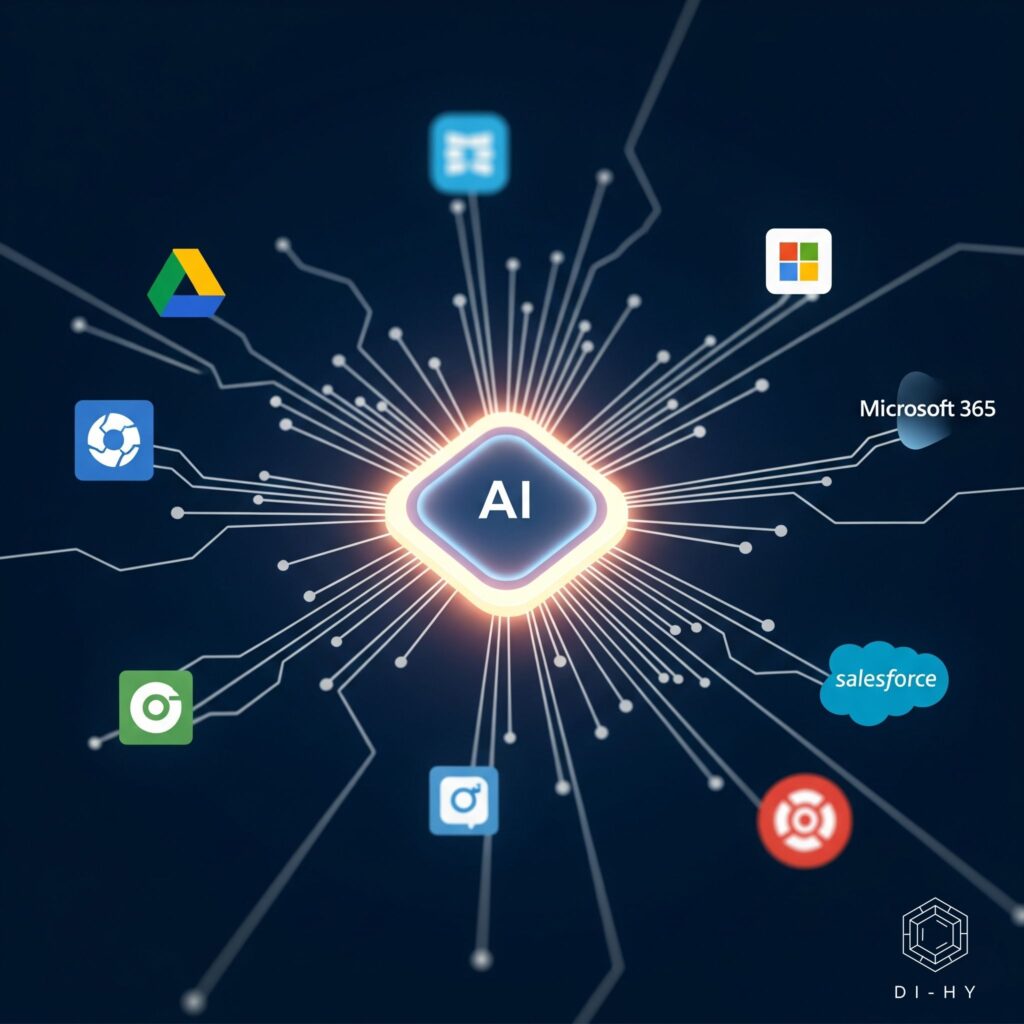
What Are OpenAI Connectors and Why Do They Matter?
In simple terms, OpenAI connectors are secure gateways that allow AI models like ChatGPT to access and interact with information stored in other applications. Think of them as a bridge between the immense analytical power of a large language model and your company’s unique universe of data.
Previously, using an AI model for a business task meant manually feeding it information through copy-pasting. This process was not only inefficient but also raised security concerns and couldn’t provide real-time context. The new, native connectors for platforms such as Google Drive and Microsoft 365’s OneDrive and SharePoint have changed the game.
The key benefits include:
- Contextual Understanding: The AI can now understand queries in the context of your company’s actual documents, spreadsheets, and presentations.
- Enhanced Security: These official connectors are built with enterprise-grade security protocols, ensuring your data is handled responsibly within your own environment.
- Real-Time Access: The AI can work with the most current versions of your files, making its outputs far more relevant and accurate.
This shift moves AI from a public utility to a personalized, internal “brain” that understands the specific nuances of your business. According to a recent report by McKinsey, generative AI could add the equivalent of $2.6 trillion to $4.4 trillion annually to the global economy, with much of that value coming from its integration into core business workflows—something these connectors directly enable.

A Day in the Life: Practical Scenarios Across Your Business
Let’s move from the conceptual to the concrete. How does this technology empower your team on a day-to-day basis?
For the Marketing Manager:
Imagine you’re planning a new Q4 campaign. Your task is to analyze the performance of all campaigns from the past two years, identify the top-performing channels, and draft a creative brief.
- Old Way: Spend hours digging through folders in Google Drive, opening dozens of spreadsheets with quarterly results, reading through old campaign reports, and manually synthesizing the information.
- New Way with Connectors: You ask the AI: “Analyze all files in the ‘Marketing Campaigns 2023-2025’ folder. Summarize the top 3 performing campaigns based on ROI and customer engagement metrics. Identify common themes in their messaging and target audience. Then, using our standard creative brief template, draft a brief for a new campaign targeting a similar demographic.”
In minutes, you have a data-backed summary and a fully drafted brief, saving you a day’s work and ensuring your strategy is built on historical success.
For the Sales Executive:
A high-value prospect has just booked a last-minute meeting. You have 30 minutes to prepare.
- Old Way: Frantically search your CRM, sift through email chains, and look for shared files to understand the client’s history, past objections, and key stakeholders.
- New Way with Connectors: You ask the AI: “Summarize our entire relationship with [Prospect Company]. Pull key information from our CRM, all email correspondence in Outlook, and the ‘Active Proposals’ SharePoint folder. What were their main pain points, who are the decision-makers, and what was the status of our last proposal?”
You walk into the meeting fully armed with a comprehensive, 360-degree view of the client relationship, ready to address their specific needs and close the deal. This level of preparation was once reserved for large enterprise teams but is now accessible to all.
For the Operations Director:
You need to create the monthly operations report for the leadership team, which involves pulling data from multiple sources.
- Old Way: Manually download CSV files from various software, consolidate them in Excel, create charts, and write up a summary of key performance indicators (KPIs). This is a tedious, error-prone process.
- New Way with Connectors: You ask the AI: “Connect to the ‘Monthly Ops Data’ folder. Consolidate the data from the logistics, inventory, and customer support spreadsheets for May 2025. Generate a summary report highlighting key KPIs, identify any anomalies or trends compared to April 2025, and create visualizations for delivery times and support ticket resolutions.”
The AI acts as your personal data analyst, automating a process that often takes days and allowing you to focus on interpreting the insights rather than just gathering the data. As Harvard Business Review notes, the value is in augmenting human judgment, not just automating tasks.
The ROI of Connected AI: Efficiency, Insight, and Innovation
The business case for integrating AI through these connectors is compelling and multifaceted.
- Massive Efficiency Gains: As seen in the scenarios above, the most immediate ROI is the reclamation of time. Repetitive, low-value tasks like searching for information, summarizing documents, and consolidating data are drastically reduced, freeing up your skilled workforce for strategic initiatives.
- Deeper, Faster Insights: Your company data holds the answers to your most pressing questions. Connectors allow you to query that data conversationally, uncovering trends and correlations that might have been missed in manual analysis. This leads to better, faster, and more data-driven decision-making.
- Fostering a Culture of Innovation: When employees are less bogged down by administrative tasks, they have more cognitive space for creativity and innovation. By making data accessible and easy to work with, you empower every team member to think like an analyst and contribute to the company’s growth.
Getting Started: How Di-Hy Digital Can Help
While these new connectors are designed to be more user-friendly, implementing them strategically to maximize value and ensure security requires expertise. Simply “turning on” the connection is not a strategy.
A successful implementation involves:
- Identifying the highest-value use cases specific to your business.
- Establishing data governance and security protocols.
- Training your team to “think with AI” and formulate effective queries.
- Measuring the impact and refining your approach over time.
This is where a dedicated AI implementation partner becomes invaluable. At Di-Hy Digital, our AI Solutions service is designed to guide Chicago-based and national businesses through this exact process. We help you move from initial curiosity to measurable business outcomes, ensuring your investment in AI technology pays real dividends.
The era of connected AI is here. Businesses that act now to integrate these powerful tools into their core operations will be the leaders of tomorrow. Don’t let the hype distract you from the very real, very practical revolution happening right now.