After-hours leads are easy to underestimate because they usually do not make noise in the moment.
The office is closed. The phones roll to voicemail. A form lands in an inbox. A homeowner asks for help at 9:42 p.m. because the issue finally became urgent enough to act on. A no-heat call in January. A water heater leaking into the garage. A breaker that will not reset.
By morning, the team sees the message and treats it like a normal lead.
That is the mistake.
After-hours demand is often high-intent demand. The customer may not wait for your business to open. They may call the next contractor, fill out three more forms, or book with the first company that gives them a clear next step.
This guide is part of our work on what missed calls cost a contractor. It covers the after-hours slice: why those leads slip, what the data says about the booking drop, and what a response path needs to do.
The lead did not die overnight. The system went quiet.
A lead that comes in after hours is not automatically cold. It is usually just unsupported.
The customer still has the problem. The service need still exists. The question is whether your business has a response path when your people are not watching the phone or inbox.
For multi-location trades operators, this gets complicated fast. One location may have a manager who checks messages early. Another may wait for the office to open. One team may call once. Another may text and follow up. Some leads get routed properly. Others sit until someone has time. The result is inconsistent recovery from a channel that should be treated with urgency.
What the data says about after-hours booking
ServiceTitan analyzed call booking rates for more than 3,000 trade businesses using June 2022 data. Two findings matter here:
- Booking rates were highest in the morning.
- Large shops booked 61% of calls at peak and 21% after 6 p.m. Small shops booked 26% at peak and 9% after 6 p.m.
That data comes from ServiceTitan customers in 2022, so it says nothing about what an AI or an answering service would book. It does show that after-hours calls convert far worse under the typical setup. That is the gap you are trying to close.
You will find other statistics online about what share of home services calls come after hours, and they range widely. We do not quote them here because we could not trace them to a primary source. Pull your own call log by hour. It takes less time than reading the vendor blogs, and it is the number you can defend.
Why after-hours leads slip away
The response window is too slow
Speed matters more when the customer feels urgency. If someone is dealing with a broken furnace, a leaking pipe, an electrical issue or a roof problem, they are not calmly waiting for a callback tomorrow afternoon.
They are trying to get certainty. If your system cannot give them that, another company might. A May 2026 Moneypenny survey reported by Contracting Business found that 83% of U.S. consumers choose the business that responds first. Moneypenny sells answering services, so weigh it accordingly, but the direction matches what every operator knows from the phones.
Voicemail creates friction
Voicemail is not a response system. It is a place where intent waits.
Some customers will leave a message. Some will not. Some will leave incomplete information. Some will assume nobody is available and keep searching. You may have heard that 85% of callers who reach voicemail never call back. We could not find the study behind that number, so do not plan around it. Measure your own: of the new-customer after-hours callers last month, how many ended up on the schedule?
The issue is not that voicemail is bad. The issue is that voicemail by itself does not qualify, route or move the customer toward a booked appointment.
Form fills feel captured but are not worked
A contact form can create a false sense of control. The lead is stored, so the business assumes it is handled. But capture is not the same as response. If a form submission does not trigger a follow-up path, the customer is still waiting.
The handoff is messy the next morning
Morning teams are busy. Phones start ringing. Existing jobs need attention. Dispatch has its own pressure. If after-hours inquiries show up as scattered voicemails, emails and CRM notes, some of them will get worked late or inconsistently.
That is not a people problem first. It is a handoff problem.
What an after-hours lead system should do
The goal is not to pretend the business is fully staffed all night. The goal is to keep the buying conversation alive until the right human can step in.
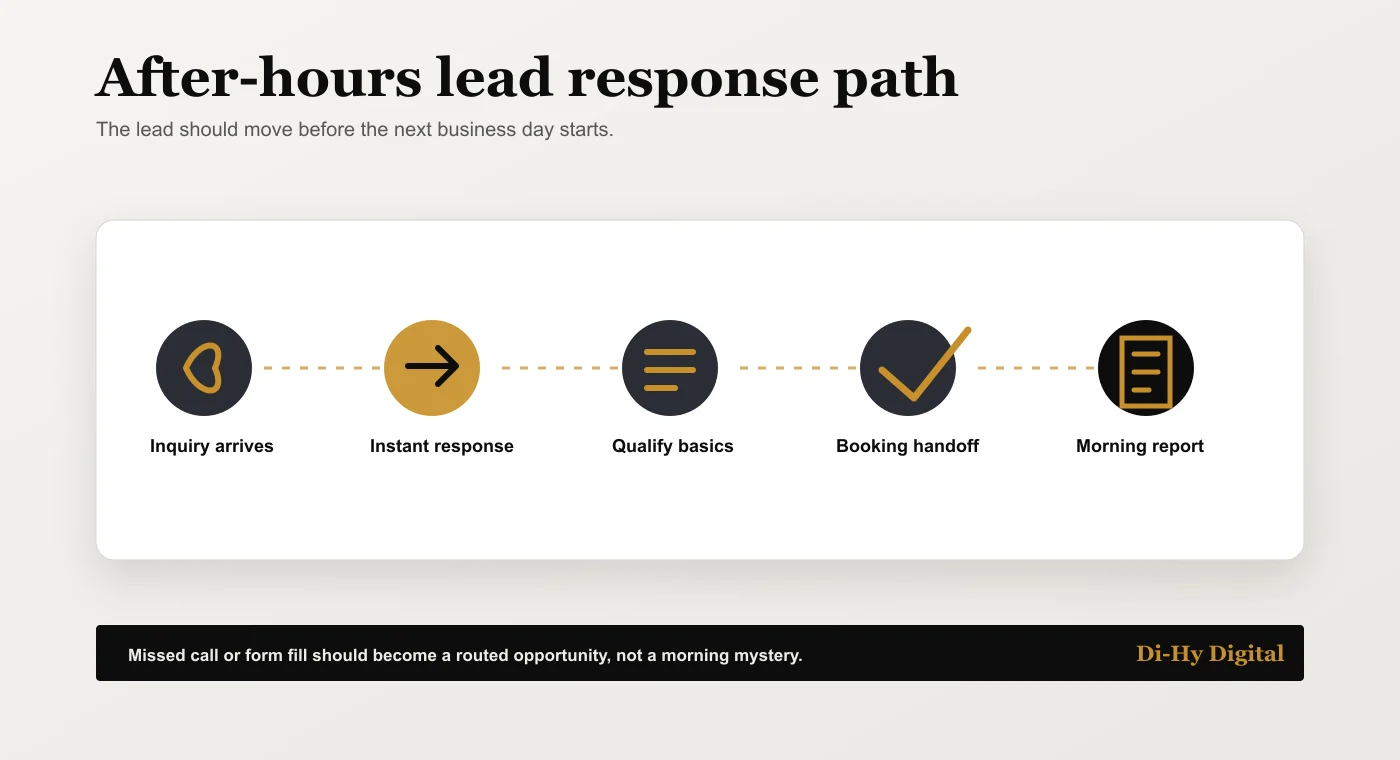
- Respond immediately. A missed call or form fill should trigger a clear next step within minutes, not hours.
- Collect the basics. Service need, location, urgency, contact information and preferred appointment window should be captured cleanly.
- Triage by urgency. A burst pipe at midnight and a request for a quote on gutter guards are not the same call. The system needs written rules for what escalates to the on-call tech and what waits for morning.
- Qualify the lead. Separate real service opportunities from noise without forcing your team to chase every vague inquiry manually.
- Route the handoff. The next morning, the right team should see what happened, what the customer needs and what action is required.
- Keep following up. If the customer does not answer the first touch, the system should continue with a reasonable multi-touch path.
Two cautions. First, if any step sends text messages, consent and carrier registration apply, and unregistered traffic can be blocked. Read the texting rules for contractors before you turn it on. Second, if a voice agent answers the call, test it on your real scenarios before you sign anything. Our AI receptionist buyer's guide lists what to test.
That is where AI is useful. Not as a gimmick. Not as a chatbot floating on a website. As a response layer that keeps revenue opportunities from going cold when the team is offline.
A simple way to size your own after-hours gap
You do not need a vendor to start. This takes an afternoon.
- Pull last month's calls and form fills with a timestamp, and split them into open hours and closed hours.
- For the closed-hours group, mark how many were new service requests rather than existing customers or spam.
- Check how many of those reached the schedule within a week, and how long the first response took.
- Multiply the unrecovered new requests by your own booking rate and first-visit ticket. Our missed call cost formula shows the full math.
If the number is small, a human on-call rotation or better overflow routing may be enough. If it is large, you have a case for a structured after-hours path.
After-hours is part of the revenue system
If your business is spending money to create demand, after-hours response cannot be an afterthought. The calls, forms and messages that come in after closing are still real buying signals. The question is whether they enter a structured path or sit until someone has time.
Di-Hy builds AI lead response systems for operators who want more of their existing demand to turn into scheduled work. The Booked-Jobs Recovery System closes that gap across missed calls, form fills, after-hours qualification, follow-up, CRM handoff and weekly reporting, live in 30 days and measured in booked jobs. For the wider picture of where leads leak between first contact and the schedule, see why contractors lose booked jobs after the lead comes in.
If you want to see where after-hours demand is leaking, book a strategy call. We will look at your response path and tell you where booked-job opportunities are getting stuck.
Frequently asked questions
Are after-hours leads worth chasing?
They can be. After-hours requests often come from people with an urgent problem who are ready to act. Whether they are worth it for you depends on your own booking rate and ticket size, which you can calculate from last month's call log.
Is voicemail enough for after-hours calls?
Voicemail records a message but does not qualify the need, escalate emergencies or start follow-up. Some callers will leave a message and some will move on to the next company.
Do I need 24/7 human staffing?
Not necessarily. Many shops use an on-call tech for true emergencies and an automated path for everything else. Written triage rules decide which calls go where.